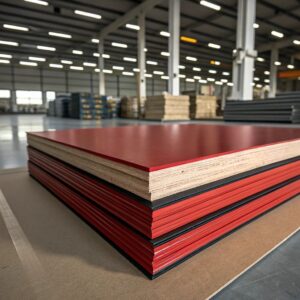
Many buyers ask me the same question — what is the standard thickness of melamine board?
This article will give you a complete guide on melamine board thickness. You will learn about the standard sizes, what each thickness is used for, and how to make the right choice based on your market and needs.
1.What Is Melamine Board Thickness?
Melamine board thickness means the total thickness of the core board plus the melamine paper on both sides. The core is usually MDF or particle board. The thickness is measured in millimeters (mm).
Here are the most common thickness options:
| Thickness (mm) | Common Use |
|---|---|
| 3–6mm | Drawer backs, cabinet backing panels |
| 9mm | Light-duty shelves, panels |
| 12mm | Wall panels, simple cabinet interiors |
| 15mm | Furniture sides, light doors |
| 16mm | European standard for wardrobes |
| 18mm | Most common for furniture and cabinets |
| 25mm | Heavy-duty worktops, shelves |

2.Why Does Melamine Board Thickness Matter?
Thickness Affects Structure
Thicker boards offer more strength. If the panel is too thin, it may bend or break. If it is too thick, it adds cost and weight. That is why most buyers choose 18mm — it balances strength and price.
Thickness Affects Price
Each millimeter makes a difference. A 12mm board can be much cheaper than an 18mm one. But using a thin board in the wrong place can cause quality problems.
3.How Thickness Affects Furniture Quality and Function
What Happens When the Thickness Is Too Thin?
Some customers try to save money by choosing 12mm or 9mm boards. In some cases, this works. For example, 12mm boards are okay for wall-mounted shelves or wardrobe interiors. But when the boards are used for cabinet doors or tabletops, 12mm is often too thin.
Thin boards may:
- Warp over time
- Crack when hardware is installed
- Feel soft or cheap to end users
I once worked with a customer from Canada named Cathy. She ordered 12mm melamine particle board for wardrobe doors. After a few weeks, the doors started bending. She lost a few clients. Later, she switched to 18mm MDF-core boards. There were no more problems.
What Happens When the Thickness Is Too Thick?
On the other hand, using 25mm boards for everything is not a good idea. They are:
- Heavier
- More expensive
- Harder to cut and process
These thick panels are best for special furniture like heavy-duty shelves, workbenches, or commercial display racks.
In regular home or office furniture, 18mm is strong enough and easier to handle.
4.Regional Differences: What Thickness Do Different Markets Prefer?
Thickness preference changes by region. Some countries care more about strength. Others care more about cost.
Market Preferences for Melamine Board Thickness
| Region | Common Thickness | Notes |
|---|---|---|
| Canada | 15–18mm | MDF core preferred, consistent surface |
| USA | 18mm | Standard for kitchens and office furniture |
| Europe | 16mm–18mm | Often MDF, meets E1/E0 environmental rules |
| South America | 12mm–15mm | Price-sensitive, mixed with local products |
| Middle East | 18mm–25mm | Thick boards used for custom furniture |
| Africa | 12mm–18mm | Flexible use, often particle board |
5.How to Choose the Right Thickness for Your Product Line
Step 1: Know Your End Use
Ask yourself:
- Will this board hold weight?
- Will people open and close it every day?
- Is it for a visible part of the furniture?
For structure or moving parts, use 18mm or more. For backing or non-load surfaces, 9mm–12mm is fine.
Step 2: Know Your Buyer’s Market
If you sell to Europe, choose 16mm or 18mm MDF-core boards with E1 glue. If you sell to South America, consider offering lower-cost 12mm particle boards.
Step 3: Consider Cutting and Assembly
Thicker boards are harder to cut and heavier to ship. They may also need stronger screws or hinges.
Here’s a quick guide:
| Part | Suggested Thickness |
|---|---|
| Cabinet sides and tops | 16mm–18mm |
| Wardrobe doors | 18mm |
| Drawer sides | 12mm–15mm |
| Drawer backs and bottoms | 3mm–9mm |
| Bookshelves | 18mm–25mm |
| Table tops | 18mm–25mm |
6.Custom Thickness and Production Flexibility at ACEALL
Many buyers ask me if we support custom thickness. The answer is yes.
At ACEALL, we can produce melamine MDF or particle board from 3mm to 30mm. You can choose thickness based on:
- Local market standards
- Shipping limitations
- Furniture design needs
We also offer:
- Flexible MOQ (Minimum Order Quantity)
- Board trimming and size customization
- Full-container or mixed-container delivery
This is helpful for importers who handle different types of projects.
For example, some of our European clients order 18mm MDF-core panels for kitchens, and 12mm particle board for drawer parts — all in one container. We manage the packing and labeling for them.
7.Conclusion
Melamine board thickness is not just a number. It affects how your product looks, feels, and performs. 18mm is the global standard, but other sizes work better in different cases. At ACEALL, I always help my clients choose the right thickness for their specific project and market.
If you are unsure about which thickness to use or want to get samples, just send me an email. I’ll reply fast — no delays, no confusion.
Contact Zoe Zang
📧 sales@aceallwood.com
🌐 www.aceallwood.com